
Sea for Peace
a land reclamation project to support a viable Palestinian state and full security for Israel
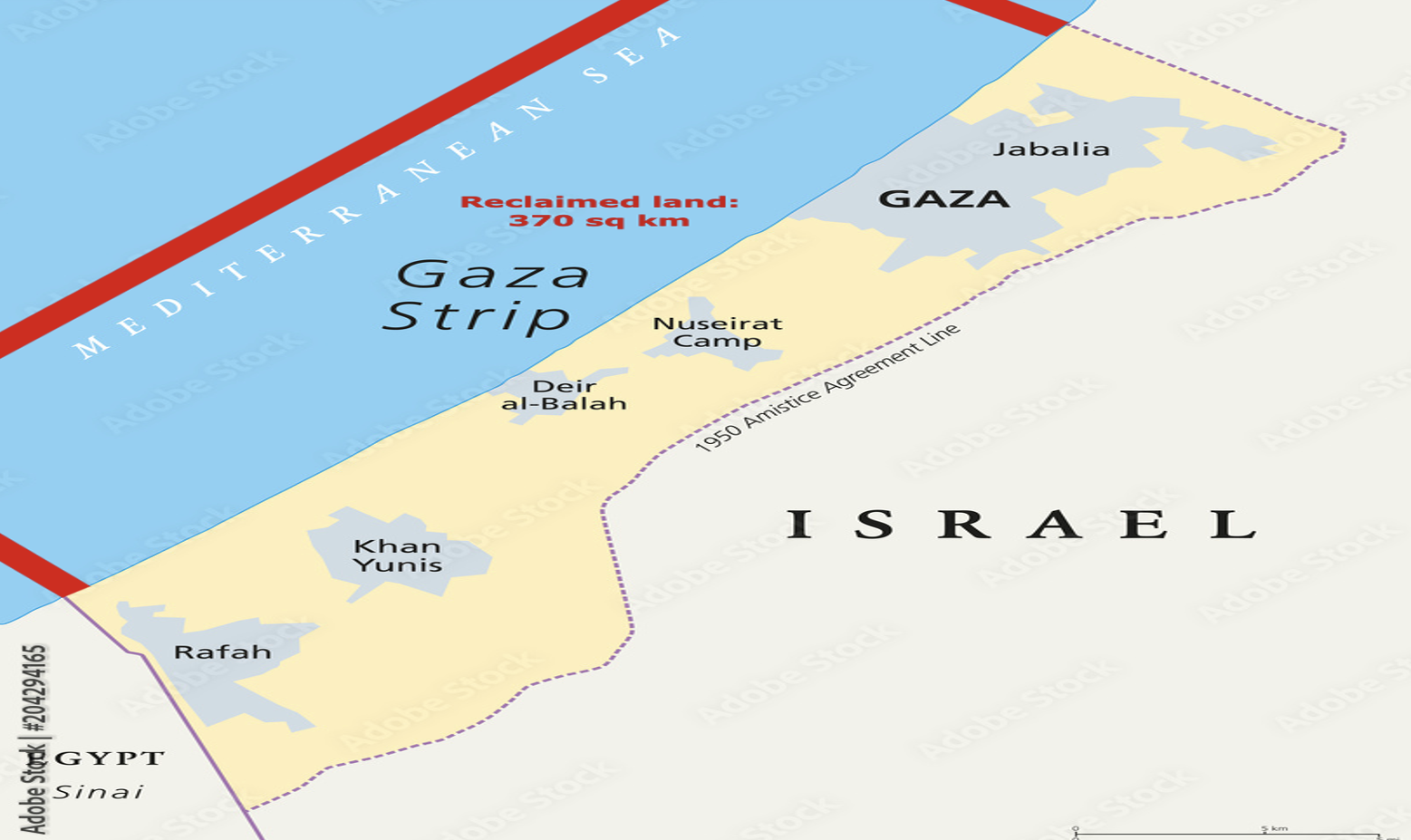
The project proposes reclaiming 370 square kilometers of new land off Gaza as a key element of a two-state peace agreement
According to BADIL's survey (published via the UN), the cumulative land expropriated from Palestinians since the Mandate totals roughly 22,285 km². This is out of a total area of historic Palestine of about 26,323 km². In other words, by this accounting Israel has expropriated land equivalent to roughly 85% of all of historic Palestine. As an element of securing a two-state space agreement between Palestinians and Israelis, it is proposed that the land mass of Gaza be doubled by land reclamation, sufficient in area to permit the full development of the new state of Palestine and the return of the Palestinian diaspora.
Land Reclamation
The proposal to build 370 square kilometers of new land off the coastline of Gaza is intended to help secure a two-state solution to the protracted Palestinian-Israeli conflict. The project would be constructed using approximately two billion tons of sandstone and granite mined and exported to Gaza for this purpose. The reclamation work would require between ten and fifteen years to complete.

Coastline Bathymetry
The near-shoreline bathymetry off Gaza is relatively shallow, at approximately 3.78 meters deep. However, the sea depth increases to forty meters at about ten kilometers offshore. While challenging, land reclamation off the coastline of Gaza is technically feasible. Importantly, it would provide Palestinians with a significant new area of arable land off Gaza for the economic development of a peaceful and prosperous state.

Reclamation Materials
All material quantities required to complete the reclamation project in a timely manner are readily available in the MENA region. All materials would be shipped through the Suez Canal and unloaded off the coast of Gaza.
Expanding Gaza’s border by 370 sq km would grow Gaza by approximately 100%.

Peace Agreement Assumption: Assuming that any peace agreement would result in the apportionment of West Bank land between Palestinians and Israelis according to the pre-1968 War borders (taking into account proposed land swaps), Palestinians would achieve a net gain of 370 square kilometers of land, which is roughly 33% more than they owned before the 1968 War under the additions of the Sea for Peace proposal.
Key incentives for an enduring peace in the Middle East: After the signing of a two-state solution, land reclamation will take approximately 10 to 15 years to complete. Upon completion, the part of New Palestine in Gaza will have access to the following:
a) Sizeable areas for the construction of national infrastructure projects, including but not limited to new schools and universities, sustainable energy infrastructure such as solar and wind power, a water desalination plant, a deep-water port, and an international airport
b) Expanses of open, arable land capable of supporting domestic food production and exports, as well as parks and lakes;
c) Additional tracts of land suitable for new housing developments, along with office and commercial spaces;
d) International zones dedicated to establishing Special Economic Zones (SEZs), essential for attracting international business investments; and
Doubling the size of Gaza will permit the return of exiled Palestinian refugees and their descendants to Palestine. It’s not a perfect ‘right of return,’ but it’s an authentic one. It will provide a million or more Palestinians and their families the right to live in an internationally recognized state governed solely by Palestinians and at peace with Israel.
The concept for Sea for Peace originated from the article ‘Sea for Peace in the Middle East,’ written by CEO Timothy Cooper and published by the Global Policy Journal on October 7, 2016.
https://www.globalpolicyjournal.com/blog/07/10/2016/sea-peace-middle-east

IMPORTANT NOTE:
The United Nations Environmental Programme (UNEP) is currently undertaking a feasibility study that is partially consistent with the Sea for Peace land reclamation proposal. UNEP is currently examining whether Gaza’s war debris can be recycled to reclaim coastal land and build artificial islands, as part of Gaza’s reconstruction.
A recent article explains: “With three quarters of Gaza’s built environment now destroyed, several reconstruction scenarios are under consideration. One of the most technically and politically sensitive options is to recycle debris to extend the enclave’s Mediterranean coastline and create artificial islands offshore.”
https://news.un.org/en/story/2026/05/1167506?utm_source=perplexity
Support “Sea for Peace” for a prosperous Palestinian state and enduring Israeli security.
Contact:
Sea for Peace
To learn more about Sea for Peace, please complete the contact form below. We look forward to speaking.